
Health and Safety Policy for Office Clearance Hounslow
This document sets out the health and safety policy for our office clearance and waste removal operations. It applies to all employees, contractors and sub-contractors engaged in office clearance, commercial waste removal and general rubbish collection across our rubbish company service area. The policy is designed to ensure a consistent, safety-led approach during clearance projects, protect staff and clients, and maintain compliance with good practice. All work must be planned, assessed and carried out with safety as the priority and with due respect for the built environment.Scope and Objectives
The aim of this policy is to minimise risk during office clearance activities and to ensure safe handling, transport and disposal of materials. It covers site preparation, manual handling, hazardous items, vehicle operations, segregation of waste streams and working in occupied premises. By implementing these controls we commit to a safety-first culture within our rubbish collection and clearance operations and across the wider service area.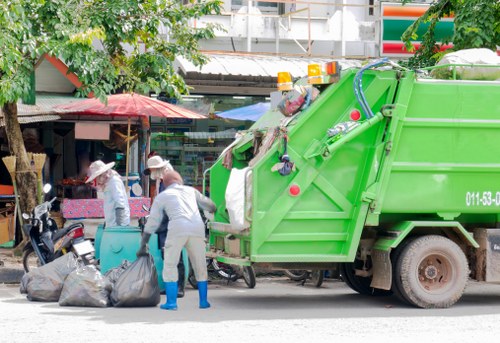 All staff must be familiar with their responsibilities. Senior managers are accountable for policy implementation; site supervisors must ensure procedures are followed; operatives must work safely and report hazards. This policy applies to staff carrying out office clearance, workplace waste removal, skip loading, small vehicle collection and any task where rubbish or waste is moved or stored. Training, equipment and supervision are provided to enable safe performance.
Risk Assessment and Planning
Every office clearance project requires a pre-work risk assessment. The assessment will identify foreseeable hazards such as trip/fall risks, manual handling challenges, electrical items, glass, sharps, liquids and any suspect hazardous materials. Controls must be recorded and include task sequencing, allocation of competent personnel, and use of appropriate tools and lifting aids. Risk assessments are dynamic and must be reviewed if conditions change during the job.Control measures include the following actions implemented on every site:
- Segregation of waste to prevent contamination and simplify recycling.
- Use of PPE such as gloves, hi-vis, safety boots and eye protection.
- Mechanical aids and team lifts for bulky or heavy items.
- Safe vehicle loading and securement to prevent shifting during transit.
 The business emphasises that safe systems of work are not optional. Supervisors will document job-specific method statements for higher risk tasks and ensure staff understand safe techniques for handling office furniture, electronic equipment, and confidential material. Confidential waste handling must also meet data protection protocols without compromising manual handling safety.
Hazardous items are treated with extra caution. Batteries, fluorescent tubes, chemical containers, and electrical goods must be identified and separated for appropriate disposal. If a suspect hazardous substance is found, work will stop and a competent person will assess the item. Never assume an item is non-hazardous. The company maintains partnerships with licensed waste carriers for controlled disposal; employees are briefed on the difference between standard rubbish collection and specialist hazardous waste removal.
Training and competence: All staff receive induction training covering manual handling, PPE use, vehicle safety, and emergency procedures. Refresher sessions are scheduled periodically and specific training provided for tasks such as safe use of lifting equipment and correct segregation of recyclable and non-recyclable materials. Records of training and competency checks are maintained and reviewed as part of routine audits.
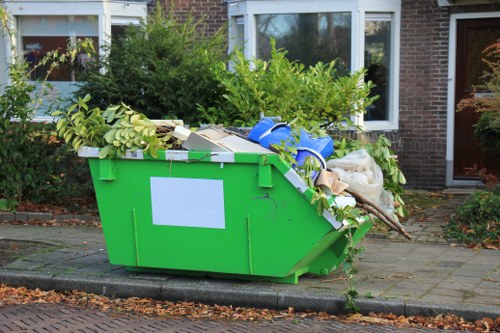 Communication on site is vital. Operatives must confirm understood instructions and use clear signals when moving bulky items. Work areas should be cordoned where needed and signage displayed to warn building occupants and visitors. Special arrangements must be made when working in occupied offices to protect staff and clients from dust, noise and access disruptions.
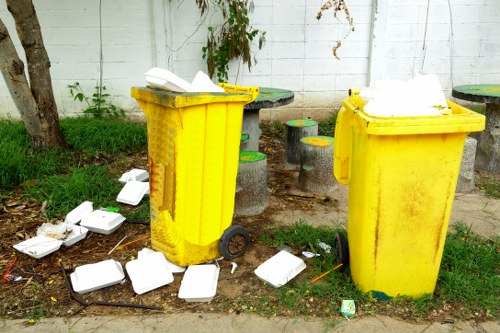 Incident reporting and first aid procedures are part of everyday practice. Any injury, near miss or unsafe condition must be reported immediately to a supervisor and recorded. Investigation focuses on root causes and practical measures to prevent recurrence. First aid kits and trained first-aiders are available on site or on-call. In addition, vehicle incidents are recorded and vehicles are regularly inspected and maintained to reduce mechanical risks.
Monitoring and review: The policy is monitored through site inspections, toolbox talks and audits. Findings feed into continuous improvement actions, changes to training, and revision of procedures. Safety performance indicators, such as incidents, near misses and audit outcomes, are reviewed by management to ensure the policy remains effective and proportionate across our rubbish removal and clearance activities.
In summary, the organisation is committed to managing health and safety during all office clearance operations and rubbish removal services within the operating service area. By emphasising planning, risk assessment, appropriate controls, training and clear communication we aim to deliver a safe, reliable and professional clearance service while protecting people and property. This policy will be reviewed periodically to remain aligned with evolving industry practice and operational needs.
